

How Do You Build the Alternative While Living Inside the System You're Replacing?
Between Code & Conscience · The People's CTO

There’s a tension I haven’t fully resolved yet. And I’m writing about it anyway.
I’m building tools to help people reclaim their relationship with technology. And I’m doing it by spending 12 hours a day on screens, optimizing for algorithms, building nurture sequences and lead magnets and funnels, measuring engagement and conversion rates.
The contradiction is not subtle.
How do you balance being an intentional founder in the creator economy — asking for the same attention you are designing to give back to others?
How do you want to take time away from screens while building a website, an app, and managing social media platforms?
How do you optimize for the same systems you analyze and critique daily?
I don’t have clean answers. But I’m naming the contradiction out loud because naming it is the first step toward building something different.
First, the scale of what we’re inside.
The average American adult spends 7 hours and 3 minutes on screens every day — more time than most people sleep. Globally, adults averaged 6 hours and 51 minutes of device time daily as of April 2026. Gen Z spends over 9 hours daily on screens at the high end of usage. Icaap + 2
We are spending the majority of our waking lives inside systems that were not designed with our wellbeing as the primary variable.
And the brain is paying for it.
Heavy smartphone and social media use is associated with measurable cognitive effects — declines in attention, memory, and executive function that in some studies resemble accelerated aging. Oxford named “brain rot” its 2024 Word of the Year. This isn’t slang anymore — it’s a documented cognitive state. Authenticity Associates
People who spend over two hours daily scrolling experience a 35% decline in prefrontal cortex impulse control — the brain region responsible for rational decision-making.
Extended social media exposure alters dopamine regulation, reinforcing addictive tendencies similar to substance dependence. Late-night digital engagement contributes to melatonin suppression and chronic sleep debt, impairing cognitive function. Pepperagency
This is not a personal failing. It is a design outcome.
The mechanism is deliberate.
Modern platforms are built on variable reward systems — the same psychological architecture that underpins gambling. Notifications, likes, algorithmic feeds: each delivers intermittent reinforcement, training the brain to seek unpredictable rewards and explaining why social media feels addictive and hard to quit. Authenticity Associates
Dopamine levels spike in response to a phone notification, which encourages checking and longer use. The most extreme form is “phantom text syndrome” — perceiving a ringtone or alert when none exists. The brain creates a false excuse because it wants you to check your phone. Kalodata
The result is not casual use. It is compulsion dressed as connection.
While users often experience short-term gratification from social media activity — receiving likes or comments — a significant number report distress or negative emotional effects and symptoms resembling addictive behaviors. Rob Dial
You feel the pull. And then you feel worse. And then you check again.
What if we got the metrics completely wrong?
Every business metric we use was designed to optimize for extraction — of attention, of time, of money. The language itself tells you:
Churn. Conversion. Retention. Engagement. Time on app.
These are not human words. They are machine words applied to human behavior.
What if we replaced them?
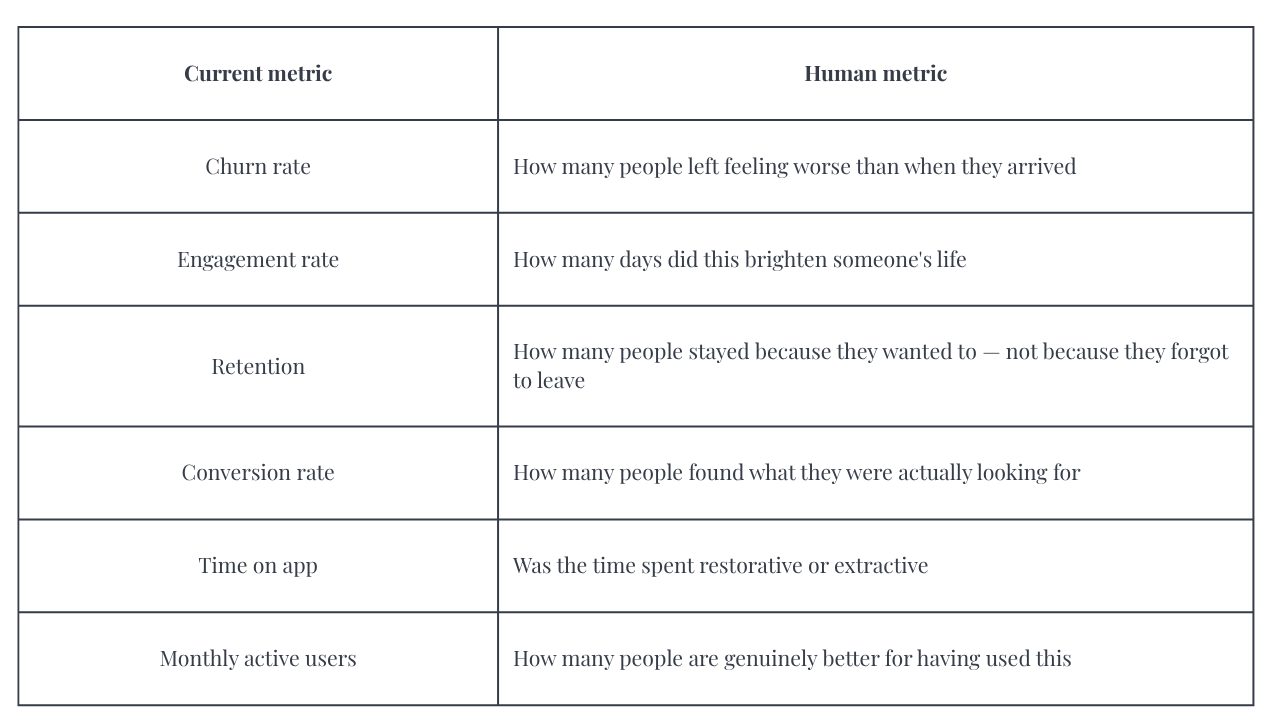
The metric isn’t the number. The metric is the human behind the number. Human-centered stops being the Figma board and UX conversations that are long forgotten several releases at Alpha when the “real data” starts to flow in.
That’s not a soft idea. That’s a harder standard than anything currently being measured.
Even the metrics for coaching, wellness, and personal businesses support productivity and hustle culture — how many hours, how many clients, how many sessions booked. But what if we measured how many days we brightened? How many users stayed and became happier — not how many left and how to prevent it next time?
What if every existing metric became an empathetic, human-focused one?
The world is changing underneath us.
People are waking up from their programming. Reading again. Dropping the masks. Showing up authentically in ways that would have felt risky two years ago. Seeking IRL experiences with a hunger that surprises even them.
The metrics don’t show this yet. But you can feel it.
My focus is clarifying. Not abandoning the build — the website, the app, the content, the markets. But holding it differently.
The goal isn’t a full funnel. The goal is something closer to Kintsugi — filling the cracks with gold. Finding clarity, coherence, and sovereignty in what already exists. And using that as the foundation for a real life of culture, language, art, and meaning.
Building your space in the digital or physical world should not require so much energy that it siphons the life you’re trying to build.
We have not yet built a signal world — one optimized for people, by people. But that’s the direction.
And here’s the thing the research actually shows.
The damage is real. And it’s reversible.
Studies show significant cognitive recovery within just one week of digital detox. Reaction times improved, anxiety decreased significantly, and sleep quality improved measurably. Sustained improvements were documented at one-month follow-up. Your brain’s neuroplasticity allows healing when behavior changes. Authenticity Associates
More importantly — intentional technology use doesn’t just stop the damage. It actively builds cognitive reserve.
A meta-analysis of 57 studies examining data from more than 411,000 adults ages 50 and older found that technology users had lower odds of cognitive impairment and reduced rates of decline over time. “Far from causing digital dementia, technology engagement is consistently linked to better brain health.” NapoleonCat
Research from the American Psychological Association indicates that learning multiple new skills in a supportive environment can, over time, help older adults achieve similar scores on cognitive tests as young adults. Social Media Today
Foreign language learning engages an extensive brain network that overlaps with regions negatively affected by the aging process — making it one of the most effective tools for building cognitive reserve. Hawxtech
The same tool that accelerates cognitive decline when used passively and compulsively — protects and rebuilds the brain when used intentionally and actively.
That’s not a wellness opinion. That’s neuroscience.
The People’s CTO exists because technology should ease and amplify your life. Not replace it.
This can look like understanding that your body is also technology. Or learning to use AI without losing yourself to it. Or building an app backed by behavioral psychology, neuroscience, and metaphysics. Or traveling with intention and with an app that helps you stay safe. Or knowing which five notifications to turn off so the first hour of your day stays yours.
Health. Wellness. Technology. Culture. These aren’t separate things. They’re the same thing. A full life.
Building your space — digital or physical — should not require so much effort that it siphons the energy you need to live that life.
We have built a world that is not yet a signal world — optimized for people, by people. But that’s what we’re building.
And I’m not building alone. I’m building with whoever is ready.

That’s not irony. That’s just how change works. That’s my journey. The person who builds the alternative usually has to survive the thing they’re replacing long enough to finish the work.
// the people’s CTO cielostud.io